This is the second part of a short series exploring a frustration I often hear from leaders.
Part 1 was about ownership and the question, “Why am I still doing everything?” This one moves us on to dependency and raises the question, “Why won’t my team step up?” And in the final part, we’ll look at performance, where the question becomes, “Why is it still not quite right?”
These aren’t separate issues. They tend to show up together, and if you only address one, the pattern usually reappears somewhere else. That’s why we’re working through them in this order.
If you prefer to listen, this topic is covered in full on the How to Lead podcast.

You’ve got good people. So why are they waiting?
Most leaders I work with aren’t dealing with capability issues. They’ve hired well, they’ve invested in their teams, and they’ve made it clear they want people to take ownership. And yet, decisions still seem to drift back in their direction.
It shows up in small, everyday ways. Draft emails pause for approval. A client pushes back, and the issue escalates quickly, often before someone has really thought through a response. In meetings, the discussion moves forward and then stalls slightly, as if everyone is waiting for a final steer.
None of this feels dramatic. It just creates a steady sense that things depend on you more than they should.
Waiting is a learned behaviour
Teams rarely begin by holding back. More often, they adjust over time in response to what feels safest.
“Just checking before I send this.”
“Can you just check this quickly?”
“I wasn’t sure what you’d prefer.”
The language sounds reasonable enough with checking in, sense-checking, and wanting alignment. It can even sound conscientious. Underneath that however, there is usually an assumption forming: that making the call independently carries more risk than pausing and asking.
That assumption doesn’t come from nowhere. It develops through repeated experiences of how decisions are handled and how responses land.
How leaders accidentally create this pattern
Most leaders don’t intend to create dependency. In fact, the behaviours that lead to it are often the same ones that helped them succeed earlier in their career.
Being reliable, improving quality, stepping in quickly when something isn’t quite right - all of these are strengths. The difficulty comes when those instincts continue unchanged as your role develops.
If you regularly refine work before it goes out, even in small ways, the standard may improve in the moment, but the thinking behind it doesn’t advance in the same way. Eventually, your team becomes more attuned to what you would do than to developing their own judgment.
It’s only subtle, but it’s enough to change how people approach decisions. They become more cautious, more likely to check, and more inclined to pass things back up the line.

The tension most leaders sit in
This is the part that often goes unspoken. Most leaders are trying to balance two things at once. They want people to step up and take responsibility, and they also want the work to be strong, particularly when clients, budgets or reputations are involved.
So you stay involved, as staying close to the detail can feel like the safest way to manage that tension. It doesn’t feel like control, it feels like care.
But that proximity has an effect. It signals, often unintentionally, that the final call still sits with you.
Move where you intervene
If you want people to step up, the change isn’t about stepping away completely. It’s about where you step in.
When attention shifts from refining outputs to shaping how people think, something different starts to happen. Instead of taking decisions back, you stay involved in a way that expands the decision-making process. Rather than acting as the final editor, you raise the level of thinking earlier on.
What this looks like in practice
1. Make decision boundaries visible
If people aren’t clear on what they can decide, they will escalate the question. Clarity around decision boundaries makes a significant difference. Making those boundaries visible removes a layer of hesitation and helps people move more confidently.
2. Slow yourself down when asked for answers
Someone asks, “What should I do?”
You probably know, but that’s not the point. Instead, ask what they’re thinking, what they’re leaning towards, or what they’re trying to achieve. Give them space to form a view before you add yours. It might feel slightly slower in the moment, but it will save you time later and build judgment rather than dependency.
3. Pay attention to your reaction when it’s not perfect
Perhaps the most important moment is when someone makes a decision that doesn’t quite land. They’ve made a call, but it’s not quite how you’d do it. That’s where your response shapes what happens next. A steady, curious approach keeps people engaged in thinking. A sharp or corrective response tends to close that down.
A simple structure helps:
Ask how they approached it
Explore what they noticed
Reflect on what they’d keep or change
Then add your perspective
You’re building capability, not replacing it.
The uncomfortable bit
There will be times when someone makes a call that you wouldn’t have made. Letting that stand, even briefly, can feel exposing, particularly when the stakes are higher.
If ownership is going to grow, though, people need to experience holding responsibility while they’re still learning, not after everything is fully formed.
Pressure reveals the real pattern
This is where patterns are reinforced most strongly. When things are calm, most leaders are comfortable saying, “Take ownership.” When pressure rises, it’s natural to revert to what feels most reliable.
That often means stepping back into the work more directly. Decisions get pulled closer, involvement increases, and the team adjusts accordingly.
If the expectation to take ownership only applies in easier moments, it never really embeds. Consistency, especially when things are busy or uncertain, is what builds trust.
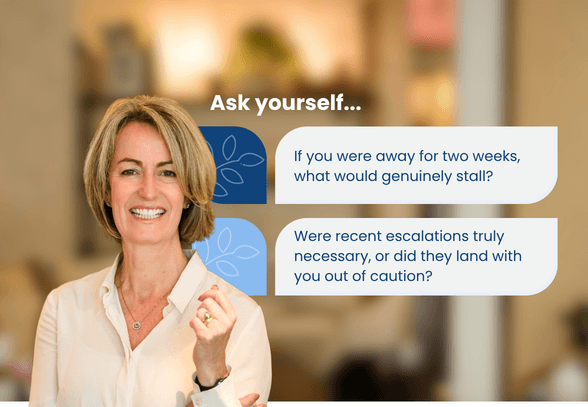
A quick check
Two simple questions:
If you were away for two weeks, what would genuinely stall?
Being specific about where decisions would stop can highlight where responsibility hasn’t fully shifted.Look at recent escalations - were they truly necessary, or did they land with you out of caution?
The answers usually point to where clarity or confidence is missing.
What to try next
There’s no need to change everything at once. Small adjustments tend to be more effective.
Leaving one piece of work untouched and asking the person leading it how they would strengthen it can be a useful starting point. Clarifying one recurring decision boundary helps reduce unnecessary escalation. The next time someone asks for directions, begin by asking for their view first to build a different habit. Let the pause do some of the work.
Final thought
When a team waits, it often reflects what they’ve learned about how decisions are handled.
As your approach shifts, their behaviour usually follows. And that’s where the change starts to hold.
If you want to explore how to embed this consistently, especially when things get busy or under pressure, that’s exactly what we work on in the Leadership Accelerator Programme.
It’s designed for leaders who want practical, real-time shifts, not just good intentions.
And if you’d like to strengthen your leadership in a way that truly lasts, you’ll find full details of my coaching, programmes and resources at waterfallhill.co.uk.