Summer has a habit of exposing leadership tendencies that remain hidden the rest of the year.
People take annual leave. Projects continue without their usual teams. Leaders promise themselves they'll switch off, only to find they're approving work between family days out or checking emails over breakfast because "it'll only take a minute." That's often when something becomes obvious.
The business still relies on them far more than they realised.
Delegation comes up in almost every leadership conversation I have. Rarely, because leaders don't understand why it matters. More often, because they're trying to find the balance between staying involved and letting go.
If you’d prefer to listen, this topic is also explored in the episode Delegation of the How to Lead podcast.

Most leaders drift towards one of two extremes. Some hold onto work because explaining it feels slower than doing it themselves. They stay close to decisions, approvals and client conversations because the stakes feel real and standards matter. Others hand work over with very little context and hope people will work it out as they go.
Linda, unsurprisingly, has perfected both.
One week, she's rewriting someone's presentation because she'd have "tweaked a few bits". The next, she's telling somebody to "crack on" before disappearing into back-to-back meetings, only to wonder later why the outcome wasn't what she had in mind.
Both approaches create dependency: one through control, the other through confusion. Neither gives people what they need to succeed.
The difficulty is that delegation is rarely about the task sitting in front of you. More often, it's about what letting go represents. It can feel risky. You've spent years building your reputation. Clients trust you. The team knows you'll notice the details. If something goes wrong, it feels easier to stay close than to accept the uncertainty that comes with somebody else taking the lead.
So you remain involved. You join the meeting and review the proposal. Answer the question that somebody else probably could have answered. Each decision feels entirely reasonable in isolation. Collectively, they create a pattern. And over time, you become the route through which almost everything flows.
Many leaders don't notice this happening because it develops gradually. You're trying to be helpful. Keeping standards high. Supporting the team. Then one day you look at your diary and realise you've attended almost every conversation, approved almost every decision and somehow become essential to work that no longer needs your direct involvement.
The irony is that delegation isn't really about removing work from your desk. It's about increasing the capability of the people around you. When delegation works well, people understand more than the task itself. They understand why it matters, what good looks like, where the boundaries sit and which decisions belong to them.
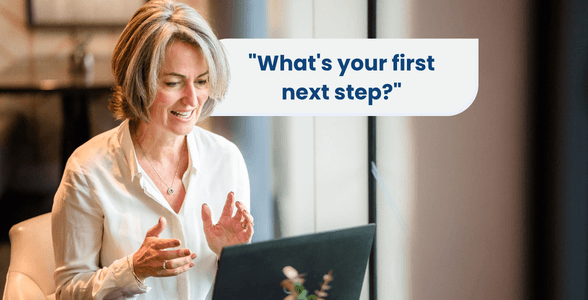
That's why one of my favourite questions during a delegation conversation is surprisingly simple:
"What's your first next step?"
It isn't a test. It's a chance to understand how the other person has interpreted the conversation. If they can explain their first step clearly, they're usually ready to begin. If they hesitate, you've learned something valuable before the work has started rather than halfway through it. That small conversation often tells you more than another ten minutes explaining the task ever could.
The other habit I encourage leaders to build is agreeing how support will work before the work begins. Too often, delegation finishes with, "Come and find me if you need anything."
Most people won't.
They don't want to interrupt you. They don't want to appear incapable or ask what they think is a silly question. So they keep going until a small uncertainty becomes a much bigger problem. Regular check-ins solve that without creating micromanagement. They provide reassurance without taking ownership back.
Perhaps the biggest misconception about delegation is that it's primarily about reducing your workload. It certainly helps with that. But I think its greatest value lies somewhere else. Every time you delegate well, you're creating another person who can think, decide and contribute without relying on you for every answer. That's how organisations become stronger. It's also how leaders create something increasingly difficult to find as businesses grow.
Thinking space.

One reason so many leaders struggle to think strategically isn't that they're incapable of it. They're still carrying work that belonged to an earlier stage of the business. The organisation has evolved, but their role hasn't quite caught up.
So the day fills with approvals, reviews, questions and decisions that somebody else could increasingly own, leaving very little room for the work that only the leader can do. Looking ahead, spotting patterns, connecting ideas. Seeing risks before they become problems.
Those responsibilities rarely appear in the diary with a meeting invitation attached. But they do require space. And space is often created one delegated conversation at a time.
When done well, delegation develops confidence, capability, and trust across the team. Done consistently, it changes the leader's role as much as it changes everyone else's.
Perhaps that's worth noticing over the summer.
Not because everything should run perfectly while you're away. Few businesses work like that. But every decision that genuinely no longer needs you creates space for someone else to grow and gives you a little more room to focus on the thinking, judgement and direction that only you can provide. That's where leadership becomes less about holding everything together and more about helping other people step forward.
If this feels familiar, and you're ready to spend less time holding everything together and more time leading with perspective, that's exactly the kind of work we explore inside the Leadership Accelerator Programme.
You'll also find the How to Lead podcast, coaching and practical leadership resources at waterfallhill.co.uk.