29 January 2026
Top five leadership techniques every manager should know
By
Kate Waterfall Hill

Most managers don’t struggle because they lack intelligence, experience, or commitment. They struggle because they’re missing a handful of practical leadership techniques that create clarity, momentum, and trust in everyday work.
Not theory. Not personality traits. Not “leadership style” quizzes.
Just consistent, learnable behaviours that help teams deliver well — especially in fast-paced agency and consultancy environments where deadlines shift, briefs change, and pressure is constant.
After coaching thousands of leaders across agencies, consultancies, professional services and scale-ups, I can say with confidence: there are five techniques that make the biggest difference to whether a team thrives or quietly underperforms.
They’re simple.
They’re practical.
And when applied consistently, they change everything.
If you’d prefer to listen, this topic is also explored in the episode Top 5 Leadership Techniques Every Manager Should Know of the How to Lead podcast.
Why everyday leadership techniques matter more than grand gestures
Leadership rarely fails in dramatic ways. It erodes quietly.
One unclear delegation becomes ten unnecessary questions.
One avoided conversation turns into months of frustration.
One missed one-to-one creates disengagement you don’t notice until it’s too late.
Great leadership isn’t about heroic moments. It’s about what happens between meetings, between deadlines, and under pressure.
These five techniques are the foundation. Miss them, and everything else becomes harder.

Technique one: Outcome-based delegation
One of the most common leadership mistakes is confusing task allocation with delegation.
Task allocation sounds like this:
“Can you do this thing?”
Delegation sounds like this:
“I want you to own this outcome.”
That difference matters more than most managers realise.
When you delegate tasks, you stay central. You remain the decision-maker, the checker, the bottleneck. When you delegate outcomes, you give people autonomy, clarity and responsibility — and you free yourself up to lead at the right level.
How to delegate outcomes (not tasks)
Effective outcome-based delegation includes five elements:
Purpose
Why does this matter? What’s the context? How does it connect to the client, the team, or the wider strategy?
Outcome
What does “good” look like in practical terms? What needs to be true by the end?
Boundaries
What are the constraints — budget, risk, approvals, timelines?
Milestones
When will you check in, and what will they bring to those check-ins?
Ownership
Unless they’re brand new, leave the how to them.
Most managers fall into one of three traps:
They delegate the task but not the context
They delegate the outcome but hover constantly
Or they abdicate and assume the person “should just know”
Outcome-based delegation avoids all three.
Instead of:
“Can you put a proposal together for the client?”
Try:
“We need this proposal to increase our chances of closing the retainer next quarter. By Friday, I need a draft that outlines our approach, timeline and budget options. I’m the decision-maker for anything over £20k. Book me for a 20-minute review on Thursday so we’re aligned before you finalise it.”
Clear. Bounded. Empowering.
Technique two: Consistent one-to-ones with a simple structure
If there’s one technique almost every struggling manager is missing, it’s meaningful one-to-ones.
Not rushed check-ins. Not status updates. Proper one-to-ones.
Even 20 minutes weekly, or 40 minutes fortnightly, can transform performance, confidence and trust — if they’re used well.
A one-to-one structure that works
You don’t need complexity. You need consistency.
How are you?
A genuine check-in on workload, wellbeing and pressure.What’s going well?
Start with progress and strengths. Confidence fuels performance.Where are you stuck?
Surface blockers early, before they become bigger problems.What do you need from me?
This shifts the focus to support and clarity, not control.What are your priorities until we next meet?
Alignment without micromanaging.
This rhythm creates psychological safety, shared accountability and forward momentum. People perform better when they feel seen, supported and clear.
Technique three: The clarity-first principle
One of the biggest myths in leadership is that underperformance is usually a motivation issue.
In reality, it’s far more often a clarity issue.
Confusion about priorities. Confusion about expectations. Confusion about what “good” actually looks like.
Clarity is the foundation of leadership. Before you delegate, give feedback, approve work or set goals, pause and ask:
Have I been explicit rather than implied?
Have I explained what good looks like, with examples?
Does this person truly understand what success looks like?
Could this be interpreted in more than one way?
A simple clarity check
Add this sentence to your leadership toolkit:
“Let me check I’ve been clear — can you summarise back what you think the goal is and what you’ll do next?”
This isn’t patronising. It’s alignment.
It will save you days of rework, frustration and unnecessary follow-up, especially in high-pressure environments where assumptions are expensive.

A leadership pause: Intentionality, support and self-awareness
Before moving on, it’s worth noticing something.
The first three techniques all rely on one underlying skill that often gets overlooked: self-awareness.
Strong leaders build in moments to notice:
What am I reacting to?
What assumptions am I making?
What story am I telling myself about this person or situation?
Am I leading intentionally — or on autopilot?
Clarity with others starts with clarity with yourself.
And here’s something leaders don’t say often enough: you don’t have to do this alone.
Leadership improves dramatically when you have someone who:
Challenges you without judgement
Helps you zoom out and think strategically
Supports reflection instead of firefighting
Brings perspective when things feel messy
Holds you accountable to the leader you want to be
That might be a coach, mentor, trusted peer or structured programme. It isn’t indulgent. It’s a strategic choice.
Technique four: High-quality feedback — fast, specific and kind
Many managers avoid feedback because they don’t want to seem harsh. But withholding feedback is rarely kind. It leaves people guessing — and guessing creates anxiety, not improvement.
Great feedback has three qualities:
Fast
Close to the behaviour, not saved for a review.
Specific
What happened, why it matters, and what better looks like.
Kind
Not soft or sugar-coated, simply delivered with care.
A simple feedback frame
Observation: “In yesterday’s client meeting…”
Impact: “It meant we didn’t fully land the strategy.”
Expectation: “Next time, pause and check what the client is actually asking for before responding.”
Treat feedback as data, not judgement. When it becomes a normal part of working together — not a big “event” — performance accelerates.
Technique five: The leadership triangle — direction, support, accountability
Every effective leader balances three responsibilities:
Direction
People need to know what matters, what success looks like, and how decisions are made.
Support
Removing blockers, providing context, offering development, and giving air cover when needed.
Accountability
Following up, reinforcing commitments, and maintaining standards.
Most managers do one or two of these consistently. Very few do all three, and that’s where problems begin.
Ask yourself:
Have I been clear about priorities?
What does each person need from me right now?
Have I followed up on what we agreed?
When direction, support and accountability are present together, teams feel both cared for and challenged, which is where performance thrives.
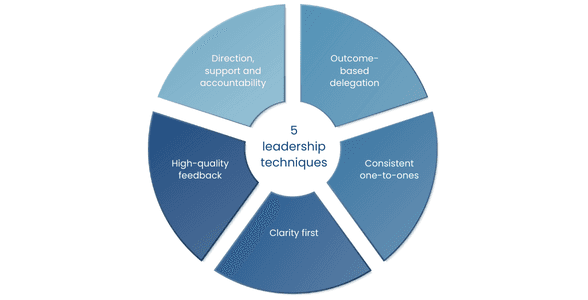
Bringing the five techniques together
To recap, the five leadership techniques are:
Outcome-based delegation
Consistent one-to-ones
Clarity first
High-quality feedback
Direction, support and accountability
None of these are complicated. But most managers apply them inconsistently, especially under pressure.
Leadership isn’t about doing everything yourself. It’s about creating the conditions where people can do their best work, consistently and confidently.
And that’s leadership that holds up in the real world, with real deadlines, real clients and real people.
A short note on going deeper
These techniques form the core of the work I do with leaders inside the Leadership Accelerator Premium, where the focus isn’t learning more theory, but applying what you already know under real pressure.
Because knowing how to lead isn’t the same as leading well.
If you’d like to strengthen your leadership in a way that actually sticks, you’ll find details of my coaching, programmes and resources at waterfallhill.co.uk.