You’re mid-week, juggling client calls, internal meetings and team queries. Then a new priority lands on your desk. “We need to focus on this instead.” You pause. Didn’t we just agree the priority was something else? What matters most now?
This is the fatigue that shows up when the goalposts keep moving. In agencies, it might be a client changing the brief mid-campaign. In corporate settings, a board reprioritises overnight. In scale-ups, funding shifts, investor expectations or rapid pivots.
The environment changes, and that’s normal. What isn’t inevitable is the instability that follows. If you would prefer to listen rather than read, this topic is also explored in the episode How to Lead When the Goalposts Keep Moving of the How to Lead podcast.

Why constant change feels destabilising
Change alone isn’t the problem. Most professionals expect markets to move, clients to adapt, and strategies to evolve. What creates stress is a lack of anchors. When leaders communicate a new priority without referencing what remains steady, teams lose footing.
Questions begin to creep in:
What do we protect?
What do we deprioritise?
What will we be measured against now?
Without clear answers, effort scatters. You see duplicated work, hesitation, frustration, and sometimes a dip in performance, not because capability has dropped, but because clarity has.
Leaders often respond by adding more intensity: more meetings, more updates, more reactive direction. It feels active, but it often adds noise and undermines focus.
I’ve seen this countless times in agencies. A client shifts a brief mid-project, the team scrambles, the account lead sends an urgent update, the creative director calls for clarifications, and suddenly everyone is firefighting again. The work gets done, but strategic thinking stalls. Leadership feels heavy, reactive and exhausting.
The solution isn’t slowing change. It’s framing it differently.
The stabilising move most leaders skip
When priorities shift, most leaders jump straight to the new instruction. “Focus here now.” What they skip is the stabilising context:
What’s changing
What stays the same
What matters most now
Most leaders only communicate the first and last. The middle piece anchors teams. It reassures them that not everything is negotiable and that identity and standards remain.
For example, in an agency:
“The client has reduced the budget, so the campaign scope is changing. What isn’t changing is our commitment to strategic quality and long-term relationships. What matters now is delivering impact within tighter parameters.”
Or in a corporate setting:
“The board has reprioritised cost management. What isn’t changing is our focus on customer experience. What matters now is identifying efficiencies without compromising standards.”
That middle sentence makes all the difference. It prevents unnecessary anxiety and scattered effort.
I often see leaders under pressure skip this step because they assume their team already understands. The result? People second-guess themselves, hesitate, or overcompensate. Even small shifts in messaging can ripple into lost focus across the organisation.
How to maintain trust and focus
Many leaders hesitate to acknowledge volatility because they worry it signals weakness. In reality, teams lose trust when change is disguised and gain trust when it is named calmly and clearly.
The difference between inconsistency and adaptability is articulation. Inconsistent direction announces a change without reasoning. Adaptability explains the logic. Teams do not need every detail, but they need to know:
Why this matters now
What external changes prompted the shift
What trade-offs are being consciously made
When reasoning is shared, change feels strategic, not arbitrary.
Take a senior creative director I coached. Her team’s client work often shifted daily. She started explicitly framing changes like this:
“The client adjusted priorities today. What isn’t changing is our approach to creative quality. What matters now is delivering the revised deliverables without compromising the bigger brand idea.”
Within weeks, team stress dropped noticeably. People asked fewer questions, worked with more confidence, and engagement improved. She didn’t stop the changes. She provided orientation.
Decision fatigue in volatile environments
Another consequence of moving goalposts is decision fatigue. When direction changes frequently, people become cautious. They hold back from committing energy because they assume something else will shift soon.
Signs include:
Short-term thinking
Low emotional investment
Repeated requests for confirmation
This is not laziness. It’s protective behaviour. If people feel the rules change unpredictably, they conserve effort. Your role as a leader is to make change feel intentional, not chaotic. That requires rhythm.
Create a cadence for change
Unpredictability is often unavoidable. But unpredictability does not have to mean instability. One of the most powerful tools is cadence.
Instead of shifting direction ad hoc, establish review points. For example:
“We review strategic priorities quarterly.”
“Client scope resets happen at defined checkpoints.”
“Budget reallocations are assessed monthly, not daily.”
When change is expected at certain moments, it feels less disruptive. People prepare for it. They do not experience it as a shock. Even if content changes, the rhythm does not. Rhythm creates psychological safety.
The moment that tests you
Now consider the moment that most undermines stability. A priority shifts. Your team expresses frustration. Someone says, “This keeps changing.” You feel defensive and respond quickly. You move on.
That moment matters. It teaches people whether they are allowed to acknowledge strain.
Here’s a better move:
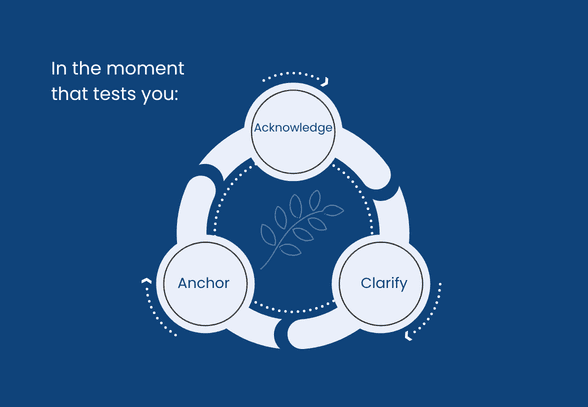
Acknowledge: “Yes, this is another shift. I understand that’s tiring.”
Clarify: “Here’s why it’s necessary.”
Anchor: “Here’s what remains steady.”
Skipping any step leaves people confused, unheard, or unmoored. Following all three builds resilience and trust.
How your tone anchors the team
Your team mirrors your behaviour. If your tone tightens, speeds up, or becomes visibly anxious, your team amplifies that. If your tone stays measured and deliberate, your team stabilises faster. People calibrate off leadership presence more than leadership slides.
You cannot always control the market, but you can control your delivery. Leadership presence becomes the anchor when everything else moves.
Practical shifts for next week
If you operate in an environment where goalposts move frequently, try these three actions:
Audit your last three priority shifts: Did you communicate clearly what’s changing, what stays the same, and what matters most now? If not, restate direction
Introduce a review rhythm: Set defined checkpoints. Even if change is constant, people commit more when they know the timeframe
Notice your tone: Slow down. Be deliberate. Avoid defensive over explaining. Measured delivery signals control
Why this matters strategically
In volatile markets, competitive advantage comes from execution under uncertainty. Teams that remain focused while others react win. That focus is built internally, through clarity, rhythm, and tone. Not by pretending change is not happening or reacting to every shift with urgency.
The most effective leaders metabolise change calmly. They provide orientation instead of chaos. They maintain consistency in presence, even when priorities are anything but.

Final thought
Goalposts will move. Clients will pivot. Boards will reprioritise. That is normal. The differentiator isn’t whether change happens, it’s whether your team feels disoriented or directed when it does. Give people orientation. Name what is shifting. Name what is not. Explain the reasoning. And hold your tone. In uncertain environments, leadership presence is the anchor.
If you want to embed these shifts properly, not just understand them, this is exactly the kind of work we do inside the Leadership Accelerator Premium programme. It’s designed for leaders who want practical tools, real-time support, and accountability as they build leadership habits that actually stick.
And if you’d like to strengthen your leadership in a way that truly lasts, you’ll find full details of my coaching, programmes, and resources at waterfallhill.co.uk.