There is a moment many leaders reach where they realise something is no longer working.
They are busy all the time. Their diary is full. Their team relies on them constantly. And yet, the bigger picture feels neglected. Progress feels slower than it should. The same issues keep resurfacing.
They know they should be thinking more strategically. They know they should be stepping back from the details. But knowing and doing are not the same thing.
This is the shift from the Engine Room to the Strategy Room. Almost every growing leader knows they need to make it. Very few find it easy.
If you prefer to listen, this topic is covered in full in the episode Moving from the Engine Room to the Strategy Room of the How to Lead podcast.
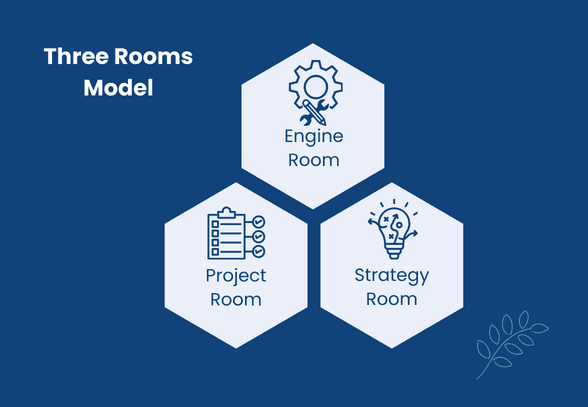
The Three Rooms leaders operate in
When I work with leaders, I often talk about the Three Rooms model. It is a simple way of understanding where your time and energy are really going.
The Engine Room is where delivery happens. This is the detail, the fixing, the firefighting, the hands on work. It is fast paced and often reactive.
The Project Room is where coordination and execution sit. It is about progress, milestones and keeping things moving.
The Strategy Room is where direction lives. This is where priorities are set, trade offs are made, risks are considered and the future is shaped.
Most leaders move between all three. The problem arises when someone who should be spending more time in the Strategy Room is still anchored in the Engine Room.
That is not a capability issue. It is a leadership design issue.
What being stuck in the Engine Room really looks like
Engine Room leadership is not just being busy. It has very recognisable patterns.
You might notice that you are the unofficial final sign off on most work, even when you are not supposed to be. You get pulled into client issues your team could handle. You quietly fix things rather than using them as learning moments. Your calendar is packed with meetings but very few of them are about the future. You feel responsible for outcomes you do not actually own.
In agencies and consultancies, this often shows up in familiar phrases.
I just need to stay close to this one.
It is quicker if I tweak it myself.
I will let them lead it next time.
The intention is usually good. You care about standards. You care about outcomes. You care about your people.
But next time never quite comes.
Why capable leaders get stuck there
This is where many leaders start to judge themselves harshly. They tell themselves they should know better.
In reality, there are very understandable reasons why capable leaders stay in the Engine Room.
First, you were rewarded for it.
You were promoted because you were good at delivery. When pressure rises, your instinct is to do more of what made you successful.
Second, control can feel like care.
You tell yourself you are helping. Often what you are really doing is protecting quality at the expense of ownership. Over time, your team learns that things come back to you anyway.
Third, no one taught you how to lead differently.
Most leaders are never shown how to replace hands-on work with strategic leadership. Instead, people leadership is layered on top of an already full job. Appraisals, holiday approvals and check ins replace thinking time rather than delivery work.
That combination is exhausting.

The warning signs that it is time to shift
There are clear signals that tell you it is time to move out of the Engine Room.
You feel constantly needed but not particularly effective.
Your team waits for your input instead of making decisions.
The same problems keep reappearing.
You regularly say you do not have time to think.
You are doing work someone else should be learning to do.
One question I often ask leaders is this:
If you were away for two weeks, what would genuinely fall apart?
If the honest answer is quite a lot, that is not a people problem. It is a leadership design problem.
What actually changes in the Strategy Room
This is the part most people rush past. Moving into the Strategy Room is not just a mindset shift. It is a behavioural shift.
Let us slow it down.
You change what you personally work on
In the Engine Room, your focus is on tasks, outputs, fixing and firefighting.
In the Strategy Room, your focus moves to priorities, trade offs, decisions, capability, risk and future direction.
A simple test can help. If a task does not require your judgement, it probably does not require you.
That does not mean you stop caring about the work. It means you stop being the person who does it.
You stop answering questions and start shaping thinking
In the Engine Room, leaders are often the answer. People come to you because you are reliable, knowledgeable and quick.
In the Strategy Room, leaders shape how decisions are made rather than making every decision themselves.
When someone asks, what should I do, or is this right, the response changes. Instead of solving the problem, you ask what options they have considered, what decision they are leaning towards and what the risk would be if it went wrong.
This feels slower at first. It is slower at first. And then it saves you hours. More importantly, it builds judgement in your team.
You design ownership instead of hoping for it
Ownership does not appear because you tell people to own things.
It appears when decision rights are clear, expectations are explicit and consequences are visible.
Leaders operating in the Strategy Room are deliberate about who decides, who executes and who needs to be informed.
If everything still comes back to you, ownership has not really moved.
You protect thinking time because it is part of the job
Strategy does not emerge in the gaps between meetings. If your diary reflects what you believe your job is, then protecting thinking time is a leadership statement.
Leaders who successfully make this shift block time for thinking, reduce unnecessary attendance and become intentional about which conversations genuinely need them.
If your diary looks exactly like it did two years ago, your leadership probably does too.
Three small changes you can make next week
You do not need to overhaul everything at once. In fact, that usually backfires.
Instead, try changing just three behaviours next week.
First, choose one piece of work you would normally step in and fix. Do not fix it. Ask the person leading it what they think needs tightening and what decision they are making. Let it go at good enough, not perfect. That is how ownership starts to stick.
Second, the next time someone comes to you for an answer you would usually give immediately, pause. Ask what options they have already considered and which way they are leaning. You are not withholding support. You are building capability.
Third, protect one hour in your diary purely for thinking. Use it to notice where decisions keep coming back to you and what you are holding on to out of habit rather than necessity.
If you do not deliberately create Strategy Room time, the Engine Room will take everything.
Why is this so hard to sustain on your own?
Many leaders know all of this already. They have read it. They have nodded along. Some have even tried it.
Then pressure hits. A deadline slips. A client complains. A team member hesitates.
And suddenly, they are straight back in the Engine Room.
That does not mean you are failing. It means you are trying to change deeply ingrained leadership behaviours while operating under pressure.
That is why support matters.
The leaders who make this shift sustainably are not stronger or more disciplined. They have structure, challenge and accountability while they practise leading differently.
No one changes leadership habits well in isolation.

The real shift
Moving from the Engine Room to the Strategy Room is not about doing less. It is about doing different work.
When that shift happens, everything else starts to change. Your team becomes more capable. Your energy returns. Your impact increases.
The best leaders are clear on the vision, care deeply about their people and approach interactions with curiosity rather than judgement.
That is what the Strategy Room makes possible.
Ready to Go Further?
If you want to embed these shifts properly, not just understand them, this is exactly the kind of work we do inside the Leadership Accelerator Premium Programme.
It’s designed for leaders who want practical tools, real-time support, and accountability as they build leadership habits that actually stick.
And if you’d like to strengthen your leadership in a way that truly lasts, you’ll find full details of my coaching, programmes and resources at waterfallhill.co.uk.