Hybrid and remote working aren’t going anywhere. Most agencies and consultancies now operate with some blend of in-office, at-home, and flexible schedules. And while the model solves plenty of problems - talent, flexibility, wellbeing - it creates a leadership challenge that’s often underestimated:
How do you build trust when your team isn’t always in the same place?
In this blog, we explore what trust looks like in remote and hybrid environments, the common pitfalls leaders fall into, and the practical habits that help teams stay connected, confident, and able to deliver - wherever they’re working from.
If you prefer to listen, this topic is covered in full in the episode Leading in a Remote or Hybrid Working Model of the How to Lead podcast.
Why trust matters more when you’re not together
Trust is the ingredient that lets teams take risks, collaborate openly, speak honestly, and move at pace. In co-located teams, trust grows almost accidentally through micro-moments - the walk to a meeting, the laugh over coffee, the “have you got a minute?” chat after a client call.
In hybrid or remote environments, those moments disappear unless you create them intentionally.
When trust is low, you’ll see it in the day-to-day:
Leaders sliding into micromanagement
Teams over-reporting to prove they’re working
People staying quiet because they’re unsure how their contribution will land
Decisions slowing down because nobody feels confident to act
Silos forming - often unintentionally - between office and remote staff
Burnout rising because people are working harder to compensate for ambiguity
But when trust is strong, remote teams can move just as quickly — sometimes even faster. Work becomes more autonomous. Decisions decentralise. People feel safe to ask for help or challenge assumptions. And leaders stop firefighting and start leading with intention.

The traps leaders fall into in hybrid and remote teams
Most leaders don’t set out to erode trust. It happens through understandable (and often invisible) habits. Six common traps tend to show up in agency and consultancy environments:
1. Proximity bias
People who are physically closer to the leader often get more voice, more context, and more informal influence. Not because they’re better - but because they’re visible.
2. “Out of sight, out of mind” thinking
A lack of physical presence can unintentionally turn into a lack of contact. Leaders assume everything’s fine until something breaks.
3. Micromanagement disguised as care
Hourly check-ins, over-detailed instructions, or tracking tools send one clear message: “I don’t trust you.”
4. Communication imbalances
Too many Slack messages create noise. Too few create uncertainty. Both damage trust.
5. Missing relationship time
In-person rapport usually develops organically. Remotely, it needs structure - otherwise it simply won’t happen.
6. Ambiguous expectations
When people don’t know what “good” looks like, they fill the gaps with worry, assumptions, and self-protection.
Naming these pitfalls helps leaders avoid repeating them. Awareness is the first step; structure and consistency are the second.
Core principles for building trust remotely
Before diving into tactics, there are a few leadership principles worth highlighting. These apply whether you’re leading two people or two hundred:
Consistency beats intensity. Trust is built through small, predictable behaviours.
Clarity over ambiguity. Clear roles, goals, and expectations reduce uncertainty.
Vulnerability builds safety. Leaders who admit they don’t have all the answers create space for others to do the same.
Equity matters. Remote and in-office members should have equal access to context and influence.
Relationships aren’t optional. Trust is built on who you are, not just what you deliver.
Keep evolving. Hybrid working isn’t static. Trust needs regular maintenance.
With these principles in mind, you can design simple leadership habits that strengthen trust every week.
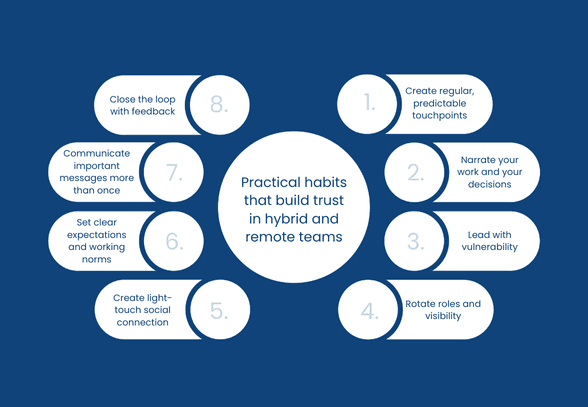
Practical habits that build trust in hybrid and remote teams
Here are the tools, behaviours, and rituals that make the biggest difference.
1. Create regular, predictable touchpoints
Don’t let connection become accidental.
1:1s with rhythm. Protect them. Use them for updates, coaching, and personal check-ins.
Team stand-ups. Short, consistent, and structured.
Hybrid equity moments. If some people are in the office and others remote, schedule a regular “all remote” meeting so nobody misses out on the informal context.
Small rituals matter. One leader asked each person to share a weekly “win or challenge” at the start of team meetings. Over time, people opened up - and the team became noticeably more empathetic and supportive.
2. Narrate your work and your decisions
Remote teams can’t see your thinking unless you share it.
Explain the rationale behind decisions.
Share drafts, agendas, and context early.
Use transparent tools so work-in-progress is visible.
Keep a simple decision log - it avoids confusion and creates alignment.
This isn’t over-communication. It’s clarity.
3. Lead with vulnerability
Psychological safety is even more important remotely.
Try language like:
“I may be wrong - tell me if you see something differently.”
“I underestimated this timeline. Help me rework it.”
Create a culture where dissent is welcome and mistakes are learning data, not performance evidence.
4. Rotate roles and visibility
Make influence equitable.
Rotate meeting facilitators and presenters.
Invite quieter or remote voices first.
Use asynchronous recognition channels so achievements don’t rely on being physically present.
5. Create light-touch social connection
This doesn’t need to be forced fun.
Coffee roulette; pairing random people for short, informal chats
Three-minute check-ins
Shared playlists
Photo prompts
“Highlight of the week” rituals
The aim is to build relational texture, not to replicate an office environment online.
6. Set clear expectations and working norms
This is where many remote teams fall down.
Co-create answers to:
When and how should we communicate?
What decisions can people make autonomously?
What does “responsive” look like?
How do we escalate issues?
Tools like RACI or DACI models help clarify who is responsible, accountable, consulted, and informed.
7. Communicate important messages more than once
Key information should be shared in multiple formats — written, verbal, and async. In remote settings, repetition isn’t patronising; it’s necessary.
8. Close the loop with feedback
Short pulse surveys help you measure trust, inclusion, and psychological safety. Share the themes you hear and act visibly on them. Even small adjustments build confidence.
A real-world scenario: bringing remote voices back into the room
Imagine you lead a team of ten. Four people are fully remote, six split their time between home and the office. Over recent months you’ve noticed something subtle: the remote team members are quieter, contribute less in meetings, and progress feels slower.
A few simple steps help shift the pattern:
1. Start by diagnosing, not assuming
Run a short anonymous pulse survey. Ask three questions:
Do you feel heard in meetings?
Do you have equal access to information?
What creates friction for you?
The remote team share that decisions often happen informally in the office.
2. Respond transparently
Share the findings with the team:
“I heard you. I’ve been defaulting to the people in the room.”
Introduce simple meeting norms: rotate facilitators, start by inviting remote contributors, and make agendas visible in advance.
3. Build relational safety
Begin meetings with a quick “highlight or concern”. Share one yourself to model openness.
4. Recognise progress and keep listening
Spotlight someone’s contribution in the team update. Run a monthly check-in: “What’s working better? What still needs adjusting?”
Change doesn’t happen overnight, but within a few months the team feels more balanced, engagement rises, and decisions move faster.
Making remote trust work: pitfalls to watch
A few final reminders as you embed these habits:
Start small - don’t redesign everything at once.
Don’t over-rely on tools. Trust comes from behaviour, not software.
Remember time zones, neurodiversity, and introversion.
Resist “control mode” when things wobble; instead, ask what’s causing the wobble.
Expect trust to dip during transitions - respond with clarity, not silence.
And above all: model the behaviour you want from others.
Trust is built through small, consistent actions - the way you communicate, the way you listen, the way you make decisions, and the way you show up for your team.

Remote and hybrid models demand more intentional leadership, not more complicated leadership. With clarity, care, and curiosity, your team can thrive no matter where they’re sitting.
If you’d like deeper support implementing these ideas, or you want structured accountability as you strengthen your leadership, you can explore how we can work together through the Leadership Accelerator Premium or my 1:1 coaching at waterfallhill.co.uk.
Because knowing how to lead isn’t the same as leading well.